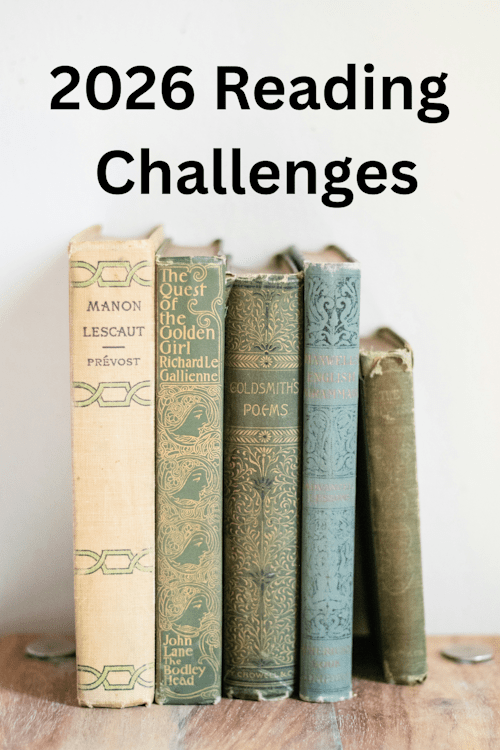
2026 Reading Challenges

I read 28 new books in 2025. That doesn’t sound like much, but I also re-read many old favorites. Some books have become comfort food in a sense. When I’m stressed or worried (which is frequent) or I can’t sleep (also frequent), I re-read books I know well. If I fall asleep, it’s okay. If I stop and move onto something else, it’s okay—I’ve read them before. My comfort reads usually involve Michael Connelly’s Harry Bosch series or L. E. Modesitt, Jr.’s Corean Chronicles.

I decided to keep my 2026 reading challenge simple: fifty new books. I read that much and more, but I need to focus on new-to-me books and get out of the rut of reading the same thing over and over. I’m on Goodreads if you want to see what I’m reading. I rarely review, which is a change for another New Year. I always have my phone with me, even when working at the library, so it’s quick to add yet another book to the TBR list!

Do you more of a reading challenge for 2026? Here are 4 for you to try:

2026 NoveList Reading Challenge. ‘For the 2026 Novelist Reading Challenge, we’re inviting your library and your patrons to join us on a journey of reading exploration to “Find What You Like.”‘ “NoveList Plus is the premiere database of reading recommendations, available through libraries around the world presenting fiction, nonfiction, and audiobooks and includes expert recommendations, reviews, articles, lists, and more.” See if your library offers this database. Their 2026 challenges encourages you to read a different genre per month to find what you like. For January, the challenge is to read a science-fiction novel.

Book Riot’s 2026 Read Harder Challenge. I wish you didn’t have to subscribe to Book Riot for complete access. You didn’t have to in the past but with the economy as it is… First challenge: Read a microhistory. I would need to look up what that is and what books are recommended.

Boston Public Library is doing a Winter Reading Challenge. “This winter, the Boston Public Library is challenging you to read a book by an author from each of six geographic regions: Africathe AmericasAsiaEuropethe Middle East, and Oceania.” This one looks like fun! I’m always reading authors from the USA or the UK. Another perspective would be fascinating.

Massachusetts Center for the Book. 12 Months. 12 Books. Nice and easy. You have the chance to win free books! Woo! January’s challenge: read a book about or set in winter.

Can you guess what state I live in? Hahaha!

Let me know if you’re planning a 2026 reading challenge and what it entails!

Tackling my TBR pile this month

I’ve got dozens of books languishing in my Kindle’s TBR pile—most from Amazon’s Prime First Reads—and I’ve been guilt-tripping myself about it while rereading old favorites for the hundredth time. Most of these books are by authors unknown to me, so I’m taking chances on each one.

I don’t want to waste time on books that aren’t clicking, but I also want to give unknown authors a fair shot. My plan is to give a book 2 chapters and then quit and move to the next if I’m not enjoying it.

Let’s see how many I can actually get through this month!

1.Ten Thousand Light Years From Okay by Tracy Dobmeier and Wendy Katzman

“A widowed and grieving young novelist believes her words create realities—both tragic and charmed—in a hopeful and surprising novel about family, newfound love, and moving on.”

I almost bailed on this one. Thea felt shallow at first, obsessing over her outfit for preschool drop-off, and the opening was heavy on backstory without much forward momentum. Usually that’s my cue to toss a book into my “Books that suck” collection and move on. But I stuck with it, and I’m glad I did. The story transformed into something beautiful and emotional about living with and through grief. It actually got to me. I might even reread it to see if those early chapters bother me less now that I know where it’s going.

Verdict: Kept reading past chapter 2—and finished it.

2. Slow Horses by Mark Herron

“Welcome to the thrilling and unnervingly prescient world of the slow horses. This team of MI5 agents is united by one common bond: They’ve screwed up royally and will do anything to redeem themselves.”

I love the Apple TV show, but like the show, this book starts slow. The opening is fantastic—River Cartwright’s operation goes spectacularly wrong, and then… did he really just get blown up!? But then it grinds to a halt with scene after scene introducing every person working at Slough House. Pure info dump.

I put it down once, picked it up again to give it a fair shot, and didn’t get pulled into the story until about the quarter mark. I imagine the sequels won’t suffer from this bland setup, but I’m not sure I’ll stick around to find out.

That said, Herron’s writing is lovely—almost poetic—while keeping the descriptions relevant to the story. That’s what kept me going.

Verdict: Finished but I doubt I’ll ever re-read it or read any more of the series

3. Tea & Alchemy by Sharon Lynn Fisher

“A tea leaf reader in nineteenth-century England falls in love—and in danger—with a reclusive alchemist.”

I’ve been in a cozy-reading mood lately, so I was looking forward to this historical vampire fantasy. Unfortunately, it reads very much like a Dracula fanfic. Mina is simple and sweet, yet somehow the smartest person in any room—including the studious vampire himself. Naturally, the vampire doesn’t want to be evil; killing people for sweet, sweet blood is a terrible burden. Mina’s blood, of course, is the sweetest of all, thanks to her descent from an ancient people responsible for the vampires’ existence. And naturally, only she can fix everything.

As long as you take it for a fluffy read, it’s enjoyable.

Verdict: finished but unlikely to be read again.

Links List: Romance Writers’ Week and Why Do We Even Read?

Prowritingaid is hosting Romance Writers’ Week starting February 12, 2024. I rarely watch the sessions live, but go through them quickly afterward. You’ve got like a week or so to review the sessions before access is cut off (unless, of course, you fork over more money!). There are usually some good tidbits along with the usual sales pitches. It’s free.

Why Do We Even Read?: “The purpose of literature is, of course, to open up new worlds and introduce information and experiences. This is what libraries do and why libraries are a monumental resource and a cornerstone of democracy. They offer a whole world to their communities that does not change based on an algorithm. It’s based on providing tools, skills, and resources that benefit as many people as possible outside capitalism, which drives data collection and the resulting feeds curated for a user rather than curated by a user.”