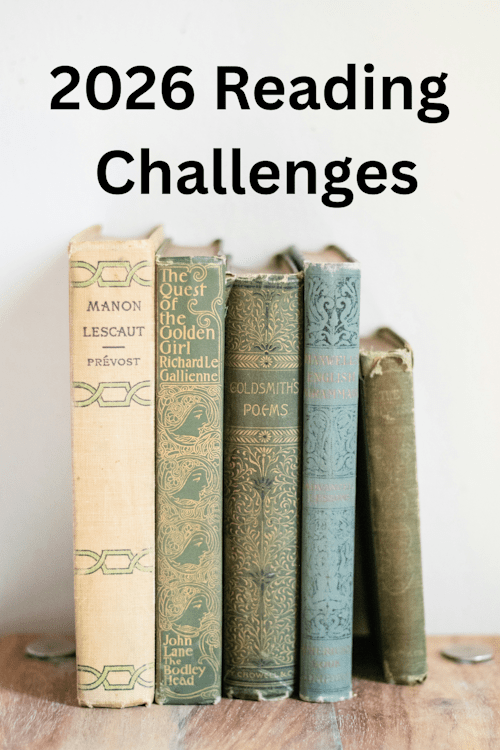
2026 Reading Challenges

I read 28 new books in 2025. That doesn’t sound like much, but I also re-read many old favorites. Some books have become comfort food in a sense. When I’m stressed or worried (which is frequent) or I can’t sleep (also frequent), I re-read books I know well. If I fall asleep, it’s okay. If I stop and move onto something else, it’s okay—I’ve read them before. My comfort reads usually involve Michael Connelly’s Harry Bosch series or L. E. Modesitt, Jr.’s Corean Chronicles.

I decided to keep my 2026 reading challenge simple: fifty new books. I read that much and more, but I need to focus on new-to-me books and get out of the rut of reading the same thing over and over. I’m on Goodreads if you want to see what I’m reading. I rarely review, which is a change for another New Year. I always have my phone with me, even when working at the library, so it’s quick to add yet another book to the TBR list!

Do you more of a reading challenge for 2026? Here are 4 for you to try:

2026 NoveList Reading Challenge. ‘For the 2026 Novelist Reading Challenge, we’re inviting your library and your patrons to join us on a journey of reading exploration to “Find What You Like.”‘ “NoveList Plus is the premiere database of reading recommendations, available through libraries around the world presenting fiction, nonfiction, and audiobooks and includes expert recommendations, reviews, articles, lists, and more.” See if your library offers this database. Their 2026 challenges encourages you to read a different genre per month to find what you like. For January, the challenge is to read a science-fiction novel.

Book Riot’s 2026 Read Harder Challenge. I wish you didn’t have to subscribe to Book Riot for complete access. You didn’t have to in the past but with the economy as it is… First challenge: Read a microhistory. I would need to look up what that is and what books are recommended.

Boston Public Library is doing a Winter Reading Challenge. “This winter, the Boston Public Library is challenging you to read a book by an author from each of six geographic regions: Africathe AmericasAsiaEuropethe Middle East, and Oceania.” This one looks like fun! I’m always reading authors from the USA or the UK. Another perspective would be fascinating.

Massachusetts Center for the Book. 12 Months. 12 Books. Nice and easy. You have the chance to win free books! Woo! January’s challenge: read a book about or set in winter.

Can you guess what state I live in? Hahaha!

Let me know if you’re planning a 2026 reading challenge and what it entails!

Book Review: Flavia de Luce 11

What Time the Sexton’s Spade doth Rust: A Flavia de Luce Novel by Alan Bradley

A Turning Point in the Beloved Series

There’s been ongoing debate in the mystery community about what constitutes a “cozy” mystery. Recently, I encountered someone describing the Flavia de Luce novels as belonging to this subgenre, which gave me pause. When I think of cozies – those mysteries I regularly shelve at the library – I picture titles with punny references to baking disasters or amateur sleuths who run cat cafés. The Flavia series has always felt different, occupying a unique space between the light-hearted charm of cozies and something darker.

This distinction has never been more apparent than in What Time the Sexton’s Spade doth Rust. To put it in perspective, I’m currently reading Ramona Emerson’s “Exposure,” which opens with the devastating murder of six children, including an infant – a book I frequently need to step away from due to its brutal realism. While Flavia’s latest adventure doesn’t venture into such explicitly dark territory, it marks a significant departure from the series’ earlier tone.

For the first time in my journey with these books, I found myself setting this one aside halfway through, not returning to it for weeks. The issue wasn’t graphic content or disturbing themes, but rather a growing dissonance that I could no longer ignore. The willing suspension of disbelief that allowed me to accept Flavia as a 13-year-old sleuth who commands adult respect finally crumbled. No matter how brilliant or precocious she may be, the cognitive dissonance of her age versus her role in these investigations has become increasingly difficult to reconcile.

Bradley’s signature elements are all present: the clever dialogue, the fascinating chemistry details, and the richly drawn world of Buckshaw and its surroundings. The previous installment had left me hopeful, with promising developments including:

  • The establishment of Dogger and Flavia’s detective agency
  • The blossoming relationship between Flavia and Undine
  • Potential for healing in Flavia’s complicated relationship with Inspector Hewitt

However, this latest entry seems to have taken a darker turn that overshadows these positive developments. While the series has never shied away from serious themes, something about this installment feels different – as if we’ve reached a crossroads where the charming eccentricity of earlier books has given way to something more sobering.

The book’s title, drawn from old folklore about death omens, proves sadly appropriate. It marks what may be my departure point from a series I’ve long cherished. The previous book had left me with a sense of optimism about Flavia’s future adventures. This one, however, opens what feels like a portal to a darker version of her world – one I’m not certain I wish to explore further.

Long-time readers of the series will find familiar pleasures in Bradley’s prose and his young protagonist’s sharp wit. However, they may also notice, as I did, that something fundamental has shifted. It’s not that the book is poorly written or that the mystery itself fails to engage. Rather, it’s that the delicate balance between youthful adventure and adult themes that characterized the earlier books has tipped, perhaps irretrievably, toward the latter.

Final Thoughts

While “What Time the Sexton’s Spade doth Rust” maintains the technical proficiency we’ve come to expect from Bradley, it may represent a turning point for many readers. The question becomes not whether the book is well-crafted, but whether this new direction serves the series’ strengths. For this reader, at least, it may be time to bid farewell to Flavia while I can still cherish the memories of her earlier adventures.

Rating: ★★★☆☆

Not because of any failure in craft, but because sometimes growing up means growing apart.

This blog post was written with assistance from Claude, an AI created by Anthropic. While the ideas and content are my own, I used Claude to help with writing, editing, and refining the text.

Another Writing Seminar

Signed up today for another writing seminar, that I’m especially looking forward to:  How Hundreds of Writers Have Leveled Up Their Craft More in 6 weeks Than 6 Years of Trying (and Failing) on Their Own with Tim Grahl from Story Grid.

I’m currently listening to the Writing Made Easy podcast where Savannah Gilbo interviews Tim Grahl about his newest fiction book and he said something that really spoke to me: ” But once I started writing the book, my goal was to just make each scene as good as it possibly can be, and he [Shawn Coyne] did do a line by line edit and amped up parts of the book as well, but for the most part it’s what I wrote and I think more than anything, people don’t understand how important that one skill is is like can you write a scene that is so compelling that people turn the page and read the next scene and, based on everything I see coming across my desk, most people can’t do that.” (Italics are mine.)

Savannah highlights this powerful quote at the beginning of the podcast: “One thing that drives me crazy about writing is that in almost every other art form we separate performance and practice as two separate activities, and in writing we just smush them together. So it’s like I’m going to learn how to write while I write something I want to publish. That’s like saying I’m going to learn how to play the guitar while playing a concert. Like that doesn’t make any sense. I wish more writers would stop trying to produce their work in progress and just become really good at the skill of scene writing.” (Italics are mine.)

So the goal for this year is to finish the damn book. The goal for next year is to practice writing compelling scenes. I’d love to take the 12 week course that Story Grid is offering but I can’t even imagine what the cost would be, especially since they’re offering a $250 discount if you do whatever. Plus you have to apply to take the course. Hopefully this free seminar will have some good information for me to start with!

Writing News: NaNoWriMo update, Getting Organized and 2 Free Seminars

Disclosure: The links provided in this post are for informational purposes only. I am not affiliated with any of the products or services mentioned, nor do I receive any compensation for sharing these resources. My goal is simply to provide you with valuable information to explore at your discretion. (This paragraph was produced in conjunction with Claude.AI. All other paragraphs were written strictly by myself.)

NaNoWriMo 2024

TLDR: I’m not officially doing NaNo this year.

I really miss the old NaNoWriMo, specifically the community that came together for the month of November in the forums. I miss the forums! That’s really why I dropped out last year beyond the fact that my local community never got together in person. And the NaNo organization basically imploded, there’s that.

I’ve been looking for a new writing community. I tried to start one locally at my library but I’d get one person at a time and I’d spend the entire two hours talking to them so it wouldn’t be awkward. But it was and I didn’t get much writing done. I’ve looked for an established local group but haven’t found anything so far.

I’d be willing to join a writing Discord but I’m not very good with Discord yet and I haven’t found a group that I’m interested in. Any suggestions are appreciated!

But I do want to do a November challenge, like NaNo, so I’ll be doing it on my own. 50,000 words on my romance novel, which won’t finish the novel but should be close.

My goal is to finish the novel by the end of the year. Just finish. It doesn’t have to be fabulous, earthshattering. Just done.

I am using this word count tracker. I may put up a widget with my word count.

Wish me luck!

Organizing a Novel

Holy shit, I’ve got so much stuff for this romance novel. Word docs, Scrivener files, text files, stuff on Novelcrafter, some AI generated ideas on Claude and ChatGPT. Many, many versions of the opening scene. Cover images. Character images. SO. MUCH. SHIT.

It’s all got to come together, in one place. I’ve owned Scrivener for years so I tried stuffing it all in there. I know so many writers love Scrivener but I find it overwhelming. It’s just too much. I had the same issue with Novelcrafter. So many bells and whistles. Too, too much.

I like Microsoft Word. Maybe it’s because I’ve used it for a long time and am familiar with it. (I always shop at the same grocery store, despite being close to several. I know where everything is in my store!) I know where everything is in Word. I know it’s a quick Google search if I need help with something. Word just works for me and I’m committed to making my life easier where I can.

But it is not good at organizing all the stuff you need to write a novel.

This week has been about collecting all the info from all the different places its stored. On my computer, in Scrivener, Novelcrafter and AI sites. I hope I’ve remembered them all! I’ve set up a simple file system: the overall folder for the project containing an IDEAS doc, a CHARACTER folder, a MASTER doc, a RESEARCH doc, an IMAGES folder, a PLOT IDEAS doc. That’s all in no particular order.

The PLOT IDEAS doc has scenes I’ve written out, multitudes of the same scene, group together by setting and time of occurrence in the story.

The IDEAS doc… I should change it’s name probably, but it has any notes or free-writes or middle-of-the-night epiphanies that I’ve jotted down.

I will be adding a word count spreadsheet and, perhaps, a scene spreadsheet that details each scene I’ve written. I think the rest is self explanatory.

I plan to write each scene in a separate doc and compile the story in the end into the MASTER. Or maybe Scrivener at that point or Atticus. I know Word has trouble handling large documents. I don’t know at once size it craps out at, so research needed.

My daughter has also played with Fictionary, so that’s worth a look.

I’m exploring like it’s the Wild West so who knows if I’ll strike gold, but I’ll keep you updated.

Unlocking Creativity & Productivity (All While Keeping Your True Voice) with Joseph Michael

October 17, 2024. This may be the same AI seminar I’ve already done but AI isn’t going away and I’m always looking to gain more knowledge of it. Free but upselling will occur, and that’s fair. I can say no easy enough.

Escape the Plot Forest 2024 from Daniel David Wallace

October 19-23, 2024. “Improve your plotting and storytelling techniques inside this supportive writing community.” I find myself getting stuck plotting out novels. The romance story I’m working on is hung up because I don’t really knows what happens after the meet-cute. I’m hoping for some sparks during this summit. Again, it’s free for a short time and then you have to pay to keep all the sessions. I tend to review each session quickly for golden nuggets so the time limit doesn’t worry me. I do like that there’s a Discord group. I wonder if it will continue after the summit is over.